An Unexpected Discovery During Our PHP Security Updates
Over the past several weeks, I have spent considerable time maintaining and upgrading the web servers used by my office. The work included addressing PHP security vulnerabilities, updating outdated software environments, and rebuilding servers that had remained largely unused for years.
These were primarily technical tasks intended to improve security, stability, and reliability. At first glance, they had little to do with immigration services themselves.
However, as I reviewed the configurations of multiple servers and websites and reconsidered the purpose of each system, I realized something unexpected.
Without fully noticing it, I had gradually developed nearly all the services I had originally hoped to provide.
What began with immigration application assistance had expanded into support for Specified Skilled Workers, IT services for Registered Support Organizations, educational programs for foreign workers, online communication tools, information services, and research into immigration policy.
Each service had been developed independently in response to a particular practical challenge. Yet when I looked at them together, I realized that they were all moving in the same direction.
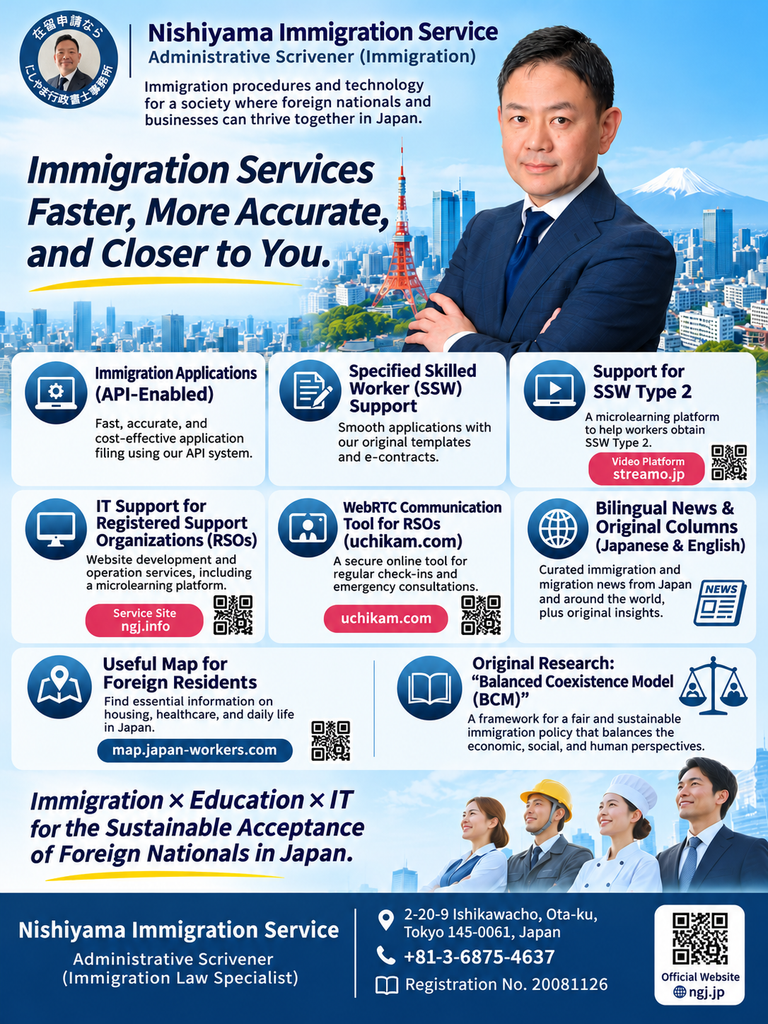
This discovery prompted me to create a new brochure for Nishiyama Immigration Service, bringing these activities together in a single presentation.
The brochure is available in Japanese and English and is designed for both A4 printing and social media platforms such as Instagram.
Making Immigration Applications Faster, More Accurate, and More Accessible
The foundation of my work remains immigration application assistance as a certified administrative scrivener in Japan.
For foreign nationals and the companies employing them, immigration procedures can determine whether they can continue living, working, or operating a business in Japan. At the same time, preparing documentation and verifying application details can be time-consuming and burdensome.
To address these challenges, I have introduced API-based immigration application processes, original application templates, and electronic contracts. I have also developed specialized tools to support applications involving Specified Skilled Workers.
The objective is not simply to digitize immigration procedures.
By reducing repetitive administrative tasks, I can devote more time to matters that genuinely require professional judgment: verifying facts, assessing legal compliance, and explaining the circumstances surrounding each application.
Combining speed, accuracy, and affordability is the real purpose of applying technology to immigration services.
STREAMO — Supporting Learning Beyond Immigration Procedures
One of the most significant developments in this broader service framework is https://www.streamo.jp/, our microlearning platform for foreign nationals.
Obtaining a residence status is not the final goal of living and working in Japan. It is only the beginning.
For Specified Skilled Workers in particular, improving Japanese language proficiency and progressing toward Specified Skilled Worker (ii) status can substantially expand their future opportunities.
STREAMO was developed to make continuous learning a practical part of everyday life.
The platform focuses on preparation for examinations such as the Japanese-Language Proficiency Test (JLPT N3) and the skills evaluation examinations required for Specified Skilled Worker (ii) status.
It combines short educational videos with review questions, allowing learners to study in manageable sessions.
Rather than requiring long periods of intensive study, STREAMO emphasizes the importance of learning consistently, even for just five minutes a day.
Learners can watch short videos on their smartphones, answer questions, and gradually strengthen their understanding.
The educational approach also aims to connect examination preparation with practical Japanese communication and decision-making skills needed in actual workplaces.
This represents an important expansion of my office’s activities.
We are moving beyond assisting foreign nationals with immigration procedures toward supporting their long-term skills development and career advancement.
Supporting Registered Support Organizations Through IT
Immigration professionals are not the only people supporting foreign nationals in Japan.
Registered Support Organizations (RSOs) and employers play essential roles in providing ongoing assistance to Specified Skilled Workers.
However, developing and maintaining dedicated IT systems can be particularly challenging for smaller organizations.
To address this issue, I have established a https://www.ngj.info/ service that supports the development and operation of websites for Registered Support Organizations.
In addition to providing an online presence, these websites can incorporate microlearning services such as STREAMO, bringing together information delivery and educational support.
Another component is https://www.uchikam.com/, a WebRTC-based communication tool designed for Registered Support Organizations.
The system is intended to facilitate regular and emergency interviews between support organizations and foreign workers through web browsers.
It is not simply a tool for conducting consultations with my own office. Rather, it is designed to support the everyday communication responsibilities of organizations assisting foreign nationals.
Some may find it unusual for an immigration administrative scrivener’s office to provide IT services.
For me, however, the connection is straightforward.
The difficulties encountered in immigration practice often reveal opportunities for improvement through technology.
Combining practical knowledge of immigration procedures with software development makes it possible to address those challenges directly.
Providing Information Is Also Part of Supporting Foreign Nationals
Through the https://www.ngj.jp/ website, I regularly share immigration-related news from Japan and around the world.
The website also publishes original commentary on immigration law, policy changes, international migration, refugee issues, and social integration.
Immigration policy cannot be understood solely within national borders.
International labor mobility, conditions in countries of origin, policies in receiving countries, and the challenges of social integration are closely interconnected.
Following international developments helps us understand Japan’s immigration system from a broader perspective.
I have also developed the https://map.japan-workers.com/ website, an interactive map designed to help foreign residents find useful facilities, services, and everyday information in Japan.
Information has limited value if the people who need it cannot easily find or use it.
Improving access to practical information is therefore another important form of support.
The Balanced Coexistence Model — The Philosophy Connecting These Activities
Alongside these practical services, I have continued developing and publishing my original research framework, the Balanced Coexistence Model (BCM).
The model approaches immigration policy not simply as a matter of securing labor or controlling residence status, but as a question of balancing rights, responsibilities, benefits, and burdens among foreign nationals, employers, local communities, and public authorities.
The model is introduced in greater detail at https://www.ngj.jp/bcm.php.
At first glance, immigration application support, educational services, IT systems for Registered Support Organizations, and access to everyday information may appear to be unrelated activities.
However, they are closely connected to the principles underlying the Balanced Coexistence Model: institutional trust, transparency, individual capacity development, and sustainable systems for accepting foreign nationals.
My objective is not merely to discuss policy in theoretical terms.
I want to develop practical solutions, even on a small scale, that respond to challenges encountered in everyday immigration practice.
At the same time, those practical experiences should inform further policy research.
The continuous interaction between practical work and policy analysis is central to my approach.
Individual Solutions Have Become an Integrated Service Framework
Looking back, I did not begin with a comprehensive plan to build a large package of services.
Instead, I responded to problems as they arose.
Could immigration applications be processed more efficiently?
Could the administrative burden on Registered Support Organizations be reduced?
Could foreign workers be given better opportunities to continue learning?
Could essential information about life in Japan be made easier to find?
Each question led to another small project.
Over time, those projects gradually became connected.
The recent server modernization provided an opportunity to review not only the technical infrastructure but also the overall value that my office can offer.
Of course, this does not mean that every service is complete.
There is still much work ahead, including expanding STREAMO’s educational content, improving integration among services, and making each system easier to use.
Nevertheless, I now feel that the essential foundation connecting immigration procedures, education, IT, information services, and policy research is finally in place.
The Message Behind Our New Office Brochure
The new brochure carries a simple message:
“Immigration Services — Faster, More Accurate, and Closer to You.”
This message extends beyond immigration applications.
It reflects my broader commitment to making complicated procedures, systems, and information easier to understand and more accessible to the people who need them.
As a small immigration administrative scrivener’s office, I have the flexibility to identify practical problems, develop solutions independently, and continuously improve the services I provide.
By combining professional immigration expertise with technology, I hope to offer meaningful support to foreign nationals, employers, and Registered Support Organizations alike.
The new brochure is available in both Japanese and English. I hope it will help more people understand how our individual services connect and what we are working to achieve.
Immigration × Education × IT.
Through this combination, Nishiyama Immigration Service will continue working toward the sustainable inclusion of foreign nationals in Japanese society, grounded in practical experience and a commitment to balanced coexistence.
Nishiyama Immigration Service
Certified Administrative Scrivener (Immigration Services)
Official Website: https://www.ngj.jp/