

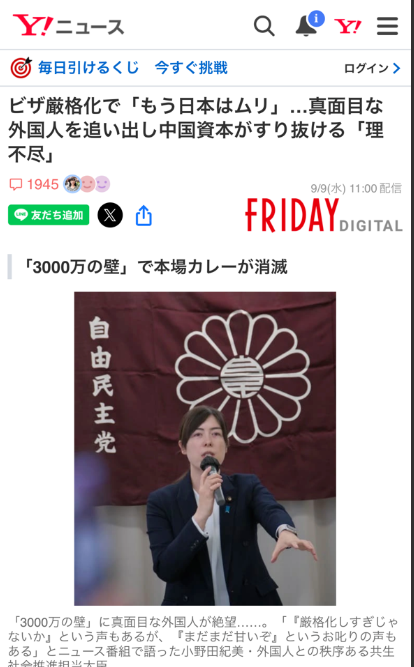
Nearly 2,000 Comments on an Article in Which I Was Interviewed
I was recently interviewed for a media(Friday Digital) article about Japan’s increasingly restrictive policies toward foreign residents. I commented on issues including the stricter requirements for the “Business Manager” status of residence and sharp increases in immigration-related application fees. My basic argument was that current policy appears increasingly driven by short-term public sentiment, while insufficient attention is being paid to whether these measures are actually effective and what their long-term consequences will be.
When the article was published on Yahoo! Japan News, it attracted nearly 2,000 comments. Some readers agreed with my views, including a journalist who explicitly expressed support for my position. However, among approximately 30 comments displayed near the top under Yahoo!’s recommended ordering, many strongly supported stricter immigration controls.
Yahoo! comments are, of course, not an opinion poll. Nor can 30 highly ranked comments be regarded as representative of Japanese society as a whole. Nevertheless, the fact that so many people felt compelled to respond—and that some comments received thousands of positive reactions—should not simply be dismissed. I believe these reactions reveal something important about the current state of Japan’s immigration debate.
“There Is a Reason the Rules Became Stricter”
One of the clearest themes in the comments was the belief that stricter rules did not emerge without cause. Readers repeatedly argued that the previous system had been too lenient, that the Business Manager status had been abused as a means of migration, and that stricter requirements were necessary to eliminate shell companies and other forms of misuse.
Some argued that “accepting foreigners is not charity” and that the interests of Japanese citizens must come first. Another commenter, who said that their company employs Technical Intern Trainees and Specified Skilled Workers, explained that the company spends considerable resources on Japanese-language incentives, dedicated support staff, intermediary fees, and assistance for workers displaced when other companies close. The commenter objected to portrayals suggesting that all employers of foreign workers are exploitative.
It would be a mistake to classify all these arguments simply as “xenophobia.” Doing so would prevent us from understanding what is actually happening.
If There Was Abuse Under the ¥5 Million Rule, Isn’t ¥30 Million Justified?
One particularly interesting criticism was directed at my own remarks. In the original article, I pointed out that even under the previous ¥5 million capital requirement, some applicants used temporarily borrowed or otherwise artificial funds simply to satisfy the requirement. One commenter responded that I was effectively admitting that the previous system had become vulnerable to abuse—and that stricter screening was therefore entirely reasonable.
That is a legitimate question.
But my argument is not that immigration screening should remain lax. I have no objection to rigorous scrutiny of companies created primarily to obtain residence status, or businesses that have no genuine economic activity.
The question is different: if people were able to manufacture the appearance of ¥5 million in capital, does raising the figure to ¥30 million actually solve the underlying problem?
If the purpose of increasing the capital requirement is to prevent abuse by people who can formally produce funds without operating a genuine business, those with sufficient financial resources may still be able to pass the test. Meanwhile, genuine small-business owners who have operated restaurants, shops, or other businesses in Japan for many years, paid taxes, and become part of their local communities may be forced to leave.
The real policy question therefore should not be whether immigration rules should be “strict” or “lenient.” It should be whether the regulatory instrument chosen actually addresses the problem it is supposed to solve.
“Then How Should We Exclude Bad Actors?”
Among the comments, one question struck me as particularly important: “Then how should we exclude people who abuse the system?”
This is precisely the question that needs to be answered.
Instead of relying primarily on formal thresholds—whether a company exists on paper or whether ¥30 million has been deposited—we should examine the continuity and substance of the business: actual transactions, revenue, tax payments, employment, business premises, and the real activities of the manager. Fraudulent intermediaries, nominee arrangements, false applications, and businesses created solely for immigration purposes should be investigated and sanctioned. At the same time, a genuine record of lawful business activity should count positively.
There is, of course, a counterargument: individualized screening costs money and requires administrative resources. That is also true. But if administrative efficiency is achieved through simple numerical thresholds, innocent people will inevitably be caught alongside those abusing the system. Digitalization and better information-sharing between public institutions should therefore be used to reduce the cost of verifying actual activity.
Distrust Also Exists on the Japanese Side
Reading these comments made something else very clear to me. The original article described growing distrust of the Japanese government among foreign residents affected by abrupt policy changes. But the comments revealed another large reservoir of distrust on the opposite side.
Are foreign residents really paying appropriate taxes and social insurance contributions? Are residence statuses being used for their intended purposes? Are some people improperly benefiting from Japan’s welfare system? Are crimes and conflicts with local communities being adequately addressed? Has the government allowed foreign residents to enter without sufficient control?
Some of the claims made in the comments require factual verification, and others cannot legitimately be generalized to foreign residents as a whole. But the existence of these beliefs itself is socially significant.
Institutional trust cannot be restored simply by telling people that they are mistaken. Government must demonstrate with evidence what is happening and what is not, correct abuses when they occur, and create mechanisms through which lawful behavior can also be made visible.
The Same Policy Can Restore Trust for One Group and Destroy It for Another
This is where the difficulty of immigration policy becomes apparent.
For Japanese citizens who believe that abuse of residence statuses has been neglected for years, stricter rules may look like a restoration of trust: “At last, the government is doing something.”
For foreign residents who have followed the existing rules, built businesses and families in Japan, and planned their lives on the basis of those rules, a sudden and dramatic change can look like a destruction of trust: “The rules were changed after we had already built our lives here.”
Both sides may therefore perceive themselves as victims of the system.
That is why immigration policy should not be reduced to a choice between “being kind to foreigners” and “protecting Japanese citizens.” Japanese citizens being able to trust the immigration system and law-abiding foreign residents being able to trust the same system are not inherently conflicting objectives.
Saying “They Are Hard-Working Foreigners” Is Not Enough
The comments also forced me to reconsider some of the language used in this debate. Simply saying that “hard-working, law-abiding foreigners are also being harmed” is not enough to persuade people who support stricter controls.
They want answers to different questions: How do we determine who is genuinely law-abiding? How do we exclude those who abuse the system? What benefits and costs does immigration create for Japanese society?
These are not questions that should be rejected. If Japan intends to accept foreign residents on a stable and sustainable basis, these are precisely the questions that must be answered.
At the same time, we must reject the opposite shortcut: assuming that someone abuses welfare, commits crime, or disregards social rules simply because that person is foreign. Immigration policy should be based on conduct and verifiable facts, not assumptions based on nationality.
Coexistence Does Not Mean Leniency
The Balanced Coexistence Model that I advocate does not call for the unlimited acceptance of foreign nationals. Illegal conduct and abuse of immigration systems should be dealt with firmly. At the same time, people who live, work, and operate businesses lawfully should be treated fairly, and policy changes affecting their lives should be sufficiently predictable.
Immigration control and acceptance. National interests and the rights of foreign residents. Administrative efficiency and individualized justice. The purpose of “balance” is not to declare one of these values absolute, but to design institutions capable of reconciling competing values.
The fact that the article attracted nearly 2,000 comments itself suggests how much anxiety and concern now surround immigration policy in Japan. After reading the comments, however, I do not believe the underlying problem can adequately be described as a simple confrontation between “Japanese people” and “foreigners.” What I see is something deeper: mutual distrust.
Foreign residents do not trust Japan’s immigration system. Japanese citizens do not trust the way immigration is being managed. And both sides increasingly question whether the government is administering the system fairly and effectively.
What is needed in such a situation is not to declare one side’s distrust legitimate and the other side’s illegitimate. We need to examine, one by one, why distrust has emerged on both sides and build institutions that are transparent, consistent, predictable, and genuinely effective against abuse.
Coexistence does not mean being lenient toward foreign residents. Nor does it mean asking Japanese citizens simply to tolerate greater burdens. It means creating a system that both can trust.