

1 Rethinking Immigration Procedures as Infrastructure
In this article, we present a simple yet transformative model in which a bank’s service platform becomes the entry point for residence status extension procedures, completed seamlessly through APIs.
Traditionally, immigration procedures have required foreign residents to act as the primary applicants, preparing and submitting numerous documents on their own. This process is often complex, time-consuming, and prone to error.
In contrast, the proposed model embeds most of these procedural steps within the bank’s service infrastructure.
As a result, immigration procedures are no longer standalone administrative acts, but become part of everyday life infrastructure.
2 A Simple Three-Step Flow
The model is intentionally designed to be simple, consisting of only three steps:
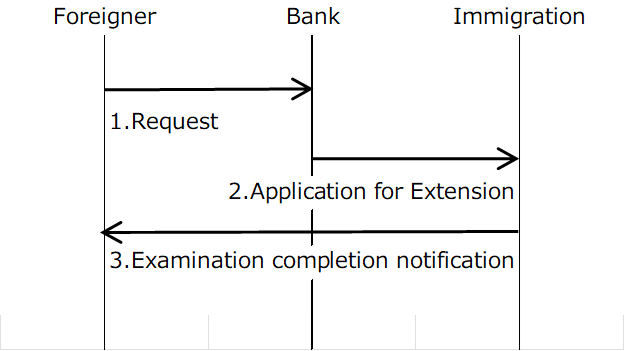
First, the foreign resident submits a renewal request through the bank’s service platform.
Second, the bank executes the application for extension of period of stay via API to the immigration authority.
Finally, the immigration authority sends the result notification directly to the applicant.
Through this structure, the procedural burden shifts away from the individual and is absorbed into an integrated service environment.
3 Benefits for Foreign Residents
The most significant value of this model lies in the drastic reduction of procedural burden.
Tasks such as preparing application forms and collecting supporting documents are largely eliminated. The process can be completed almost entirely through a simple request on the bank’s platform.
Furthermore, by introducing automated reminder notifications—such as emails sent three months before the expiration of the period of stay—the risk of missing renewal deadlines can be effectively mitigated.
In this model, immigration procedures transition from something that must be consciously managed to something that is passively maintained.
4 Benefits for Banks
For banks, the primary advantage lies in customer acquisition and retention.
By offering immigration procedures—an essential function in the daily lives of foreign residents—banks evolve beyond financial institutions into platforms supporting the overall living infrastructure of their customers.
This creates a strong incentive for foreign residents to open accounts and fosters long-term customer relationships.
In other words, compliance-related processes can be transformed into strategic assets for customer engagement.
To prevent confusion during the special period
Because the process of obtaining an extension of the period of stay or a change of status of residence takes a long time from application to notification of the result, a measure is in place to prevent illegal overstaying for two months after the expiration of the period of stay, if either application is submitted before the expiration of the period of stay. This period is called the special period. (Special period for extension/change)
Banks are responsible for managing the residence permits of foreign nationals who hold accounts. They must continuously check their databases to ensure that foreign nationals whose residence permits have expired are not overstaying their visas.
If this model is implemented, banks will no longer need to make unnecessary phone calls to foreign account holders during the special period.
5 Defining the Target Use Case
This model is designed for a clearly defined and typical scenario:
Foreign nationals holding an “Engineer / Specialist in Humanities / International Services” status
and applying for an extension of their period of stay without changing employers.
In cases involving job changes or status changes, additional individual assessment is required. Such scenarios necessitate a different workflow, potentially incorporating administrative scriveners, and will be addressed in a future article.
6 A Corporate-Centric Business Strategy
A key document in this process is the “Statutory Report on Total Amount of Salary Payments,” which can only be prepared by the employer.
This creates an important design insight:
Banks should target not only individual foreign residents, but also the companies employing them.
By onboarding companies and enabling bulk account setup for foreign employees, banks can establish a system in which required documents are regularly provided by the employer.
As a result, the documentation burden on individual applicants can be minimized—potentially reduced to submitting only a facial photograph.
Information such as residence cards and passports can be pre-registered within the bank’s system and updated through simple uploads. In the future, integration with Japan’s My Number system and next-generation residence cards could enable automated data retrieval via secure applications.
7 Toward the Infrastructure of Immigration Procedures
The essence of this model lies in the infrastructuralization of immigration procedures.
By embedding immigration processes into existing social infrastructure—such as banking systems—the stability of foreign residents’ lives can be significantly enhanced.
At the same time, a new ecosystem emerges, connecting companies, financial institutions, and immigration authorities.
This represents a core use case of Immigration RegTech, with the potential to fundamentally reshape how foreign residents interact with Japanese society.
8 Practical Feasibility
As a provider of immigration procedure API services, Nishiyama Chizai Co., Ltd., together with its user Nishiyama Administrative Scrivener Office, possesses the practical expertise necessary to implement such a model.
This is not merely a conceptual proposal, but a realistically achievable system grounded in operational experience.
NIC, a provider of API services for residence application procedures, and Nishiyama Immigration Service, a user of its services, possess the know-how to realize such a system.