

An Insurance-Centered API Model for Residence Extension
In this article, we present a model in which an insurance company’s service platform becomes the starting point for completing an Extension of Period of Stay application through an API.
Traditionally, residence procedures in Japan have required foreign residents themselves to prepare application forms and collect multiple supporting documents.
In this model, however, most of these tasks are embedded within the insurance company’s service infrastructure.
Process Overview
The model consists of a simple three-step flow.
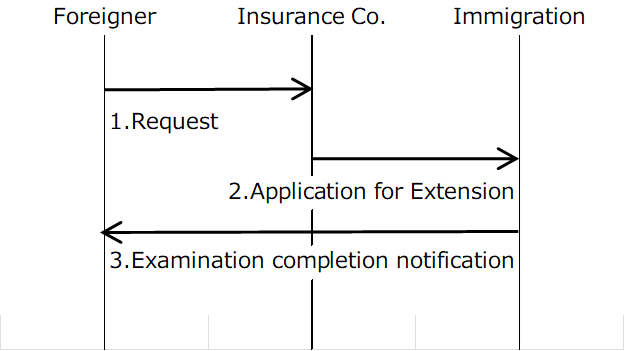
First, the foreign resident submits a renewal request through the insurance company’s service platform.
Second, the insurance company submits the Extension of Period of Stay application to the immigration authority via API.
Finally, once the review is completed, the notification is sent directly from the immigration authority to the foreign resident.
While the applicant remains the foreign resident, the operational burden of the procedure is effectively handled by the insurance company’s system.
Benefits for Foreign Residents
The most significant benefit is the drastic reduction in administrative burden.
There is no need to fill out application forms or prepare supporting documents.
In practice, the process is almost entirely completed by simply submitting a renewal request.
In addition, reminder emails are automatically sent from the insurance platform starting three months before the expiration of the residence period, eliminating the risk of missing renewal deadlines.
Residence procedures should function as part of everyday life infrastructure, and this model moves in that direction.
Benefits for Insurance Companies
For insurance companies, the key advantage lies in acquiring and retaining a growing segment of foreign customers.
The number of foreign residents in Japan continues to increase, and maintaining continuous engagement with this segment has strong strategic value.
In particular, medical insurance and non-life insurance products align well with the time-based nature of residence status, offering realistic profitability potential.
While life insurance may present actuarial challenges, other insurance products can be effectively integrated with residence procedures to create new service value.
Key Points of the Model
This model focuses on the most typical case:
an Extension of Period of Stay under the “Engineer/Specialist in Humanities/International Services” status without a job change.
In other scenarios—such as job changes or status changes—additional flows involving administrative professionals (e.g., immigration lawyers or certified administrative procedures specialists) would be required, and these will be addressed separately.
A critical document in this case is the “Statutory Report Summary (Hotei Chosho Gokeihyo),” which summarizes employees’ income data.
Since only the employer can prepare this document, the logical business target for financial and insurance institutions is companies employing foreign workers.
By onboarding such companies and collecting this document annually, the burden on the foreign resident can be reduced to almost zero.
In practice, the only document the resident would need to prepare is a facial photograph.
Residence card and passport data can be uploaded and securely stored on the service platform.
In the future, as residence cards are integrated with My Number cards, this process may be further streamlined through digital reading applications.
Integration with Bancassurance
The essence of this model is not merely procedural simplification.
It represents the integration of financial services and residence systems into a unified infrastructure.
By combining banking and insurance services within a bancassurance framework,
this model enables a seamless, integrated service experience for foreign residents.
Account management, insurance coverage, and residence procedures are no longer fragmented processes but become part of a single ecosystem.
This marks a shift from viewing residence procedures as administrative tasks to recognizing them as social infrastructure.
Conclusion
The lives of foreign residents are deeply connected to employment, finance, and insurance.
Yet these systems remain largely disconnected.
This model demonstrates how those divisions can be bridged through institutional design and technology.
The residence procedure API is only the starting point.
The real challenge—and opportunity—lies in embedding it into everyday infrastructure.
In that process, bancassurance itself evolves—
moving beyond a distribution channel to the next stage of integrated service delivery.
*This post is positioned as a chapter that makes up the table of contents in the Balanced Coexistence Model.